Missouri School Wastewater Testing Program
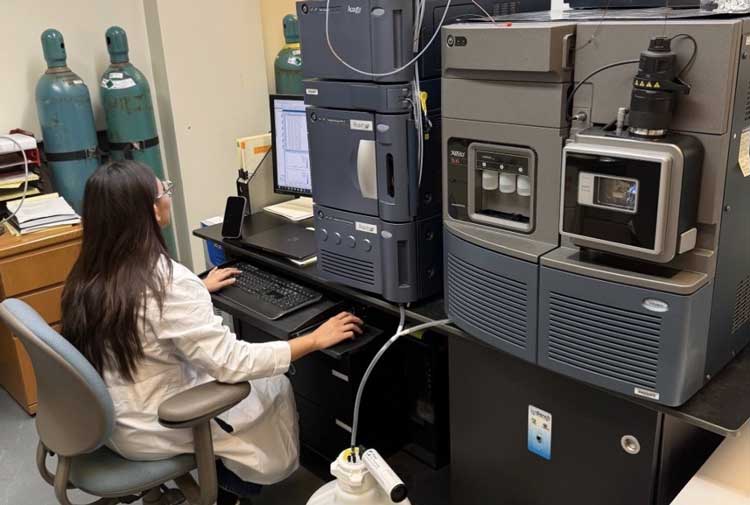
School wastewater samples are analyzed in the Bioanalytical Chemistry Laboratory and Bioremediation Program at the University of Missouri School of Natural Resources.
Appropriation bills HB 2002 and HB 2008, signed into law by Governor Mike Kehoe on June 30, 2026, included $4 million for the Missouri Department of Public Safety (DPS) to administer mandatory testing of wastewater from public and charter high schools during the 2026-27 school year in coordination with the Missouri Department of Elementary and Secondary Education (DESE). The testing is designed to detect fentanyl and other dangerous drugs and drug metabolites to protect student and public health and act as an early warning system for highly dangerous synthetic opioids that might be introduced into Missouri. Working with the Missouri Department of Health and Senior Services (DHSS), DPS contracted with Stercus Bioanalytics to oversee the testing program. To ascertain sufficient trend data through repeated testing and comparison of test results, 164 of Missouri’s over 500 school districts are expected to be tested during the 2026-27 school year. The testing is at no cost to the school districts.
Public Wastewater Testing Results Portal
Wastewater test results are aggregated by Missouri State Highway Patrol troop (region) and released as one set of results for the region each week. These results are released after designated school officials receive access to individual results for their school.
Frequently Asked Questions
Is this the first year for the program?
DPS administered a similar wastewater testing program during the 2025-26 school year, but the program was voluntary and fewer than 40 schools participated.
How were the schools selected for testing for the 2026-27 school year?
Schools were selected through a randomized selection process that was designed to include schools from each of the Missouri State Highway Patrol’s nine troops (regions) in each round of testing. This was designed to include a mix of rural, urban and suburban schools across the state.
How often are the schools tested?
Wastewater samples are collected from schools across the state once a week, but the sampling schedule is designed to collect from a different pattern of schools each week. This allows the program to track potential trends over time. For instance, School A might be tested during Weeks 5, 6, 7, 16, 17, 18, 22, 23, 28, 29, and 30 of the program during the 2026-27 school year.
Is the testing conducted at elementary, middle and high schools?
The testing is generally only conducted at high schools. In a limited number of cases middle or elementary classes may be included if they are in a combined building.
How does the testing work?
When a school is selected through the randomized selection process, collection personnel work with school staff and review building blueprints to ensure that the selected collection site is only collecting wastewater from the school building and there is no contribution of wastewater from a non-school source. Collection personnel also review school calendars and campus event schedules. The sample is then collected over the course of a single school day, to ensure that wastewater contributions only come from students, teachers, staff and visitors to the building during a normal school day. The wastewater samples are collected and tested in the Bioanalytical Chemistry Laboratory and Bioremediation Program at the University of Missouri School of Natural Resources.
What substances are being tested for?
For the 2026-27 school term, testing includes Fentanyl, Carfentanil, Cychlorphine, Brorphine, Metonitazine, N-Pyrrolidino Protonitazene, Cocaine, Xylazine, the metabolites for each of those, Methamphetamine, 3-Hydroxy Medetomidine, 7OH-Mitragynine, Mitragynine Pseudoindoxyl, as well as other substances.
Does a positive result mean drugs have been used in the school?
A positive result means that a person who contributed to the wastewater of the school during the sampling period (school hours) used or came into contact with the substance within the last 24-72 hours, depending on the drug being tested. This could include students, faculty, staff or visitors. There is no testing method that can determine who contributed the substance to the school’s wastewater or whether the substance was contributed by a student or whether the substance was consumed or handled on school property.
How should negative test results be interpreted?
A negative result means that no one who contributed to the wastewater of the school during the sampling period (school hours) used a substance included in the testing panel within the last 24-72 hours, depending on the substance being tested.
Who receives the test results and how are they reported?
The leadership of each school receives its results through a test results portal set up for each school. School personnel register and are assigned access only to their school’s report. The Missouri Department of Public Safety will have access to all results of the testing and may share those results with the Missouri Department of Health and Senior Services and other agencies as necessary to further public health and safety.
Can members of the public view the testing results?
DPS hosts a website for the public that aggregates result by Missouri State Highway Patrol troop. Results from all schools in the troop are consolidated and reported as one result for the region. These results are generally released seven days after school officials receive access to the results for their school.
Why are wastewater testing results for the public being released regionally and only after the individual results have been shared with schools?
The testing program was created to protect student and public health and act as an early warning signal for potential trends related to dangerous substances. Releasing the results for all tested schools in a region better demonstrates potential regional trends, without unfairly labeling a specific school or community. A positive wastewater result could from a single person using a substance, and the results may vary widely from week to week.
When did testing begin for the 2026-27 school year?
Wastewater samples were drawn from the first group of schools in late September 2026. There are five groups of schools. It is expected that samples will be collected 11 times from each school in the program for 2026-27.
What is the Missouri State Highway Patrol’s role in the wastewater testing program and are test results shared with other law enforcement?
As stated above, the primary reason for wastewater testing is to protect student and public health. Highway Patrol Public Information and Education Division troopers act as liaisons to schools in the testing program. They are available to conduct programs for students, staff and parents at no cost. PIED troopers regularly did this during the 2025-26 school year. The presentations were well received.
If a substance and pattern of detection could constitute a public safety threat, DPS could potentially notify law enforcement as part of a comprehensive health and public safety response, but the wastewater testing program was not developed for this purpose.
Did the wastewater testing program yield any unexpected results in the 2025-26 school year?
The 2025-26 school wastewater testing program led to a public health advisory in Missouri for nitazenes because the synthetic opioids that are 10 or more times more powerful than fentanyl repeatedly appeared in wastewater in schools from regions around the state. Fortunately, the presences of nitazenes in wastewater samples declined as the 2025-26 school year progressed and eventually disappeared entirely.
Does this program involve testing drinking water in the schools?
The program administered by DPS only tests wastewater or sewage. There is no testing of drinking water in this program.
Is the school program the only wastewater testing program the State of Missouri administers?
It is the only state program monitoring school wastewater. The Missouri Department of Health and Senior Services monitors community health by testing sewage samples from sewage treatments plants around the state weekly for disease pathogens, such as the COVID-19 virus, influenza (flu) virus, and Respiratory Syncytial Virus (RSV). This system can provide an early warning of disease spread in communities, even if some people are asymptomatic or have not yet developed symptoms.
The Missouri Department of Natural Resources also collects and analyzes sewage plant samples for water quality parameters as part of their operating permit process in order to discharge into the waters of the state.